Offering real world advantages as well as time, cost and environmental savings. Early adopters could see the potential benefits but were forced to navigate the minefield of glitchy connections, horrible cross compatibility, weird and wacky ideas and high pricing.
Although the first smart devices were introduced in the mid 60’s, they didn’t gain mainstream traction until the early 2000’s. Fast forward 20 years and the smart home has come a long way, estimated to be worth $84.5 Billion dollars in 2024, smart home devices are commonplace.
In order to overcome the early oddities of home automation, smart home companies turned to user-centric design. Where focus was on the end user rather than the idea. By focusing on the user’s needs, barriers to entry are removed and adoption of ideas becomes far easier and quicker.
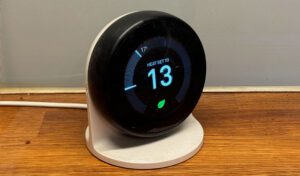
A critical element of user-centric design is the development of intuitive and user-friendly interfaces. Both physical and digital. By creating interfaces that are easy to navigate and understand, smart home companies have made it easier for users to interact with their devices and control their smart home ecosystems from their mobile device. Whilst great user-centric design has enabled physical products to function in a predictable way, yet seamlessly merge into any home setting.
Whilst the digital interface has improved to be usable by the largest of technophobe, great product design has enabled physical installation to be carried out by the most impractical of people. By simultaneously working on product, packaging and instructions, installation becomes quick and simple. Designers have focused on developing and integrating whole installation systems into the physical products, with purposely built brackets clips and magnets. The ultimate goal is to simplify the end users installation process into a few simple steps.
In addition to simplifying installation and improving usability, smart home companies have also focused on personalizing the user experience. By offering customization options and tailored solutions, users can create smart home environments that meet their specific needs and preferences. From custom colour light scenes for watching movies, or alerting you when your amazon parcel arrives, this customisation fits seamlessly into your everyday life. This personalization not only enhances user satisfaction but also fosters a deeper connection with the technology, leading to increased usage and brand loyalty.
The integration and connectivity capabilities of smart home devices have played a crucial role in their widespread adoption. Cross-compatible ecosystems that allow different devices to work together seamlessly, as well as integration with the Internet of Things (IoT), have made it easier to monitor their homes. Automatic heating and lights turning on when you return homeware are only the start, imagine monitoring your environment temperature and humidity so that windows automatically open or shut are not too far away.
Smart home technology offers genuine savings in terms of time, costs, and environmental impact. By automating routine tasks, optimizing energy usage, and streamlining processes, smart home devices can help users save time and money while also reducing their carbon footprint. This combination of practical benefits makes smart home technology an attractive proposition for consumers looking to save money whilst also contributing to sustainability efforts.
Looking ahead, the future of smart home technology holds even more promise. Already data-driven innovation has been instrumental in the advancement of smart home technology. By leveraging analytics and insights from user interactions, companies can continuously improve their products and services.With advancements in artificial intelligence (AI) poised to further revolutionize the way we interact with our living spaces. By incorporating AI-driven capabilities such as predictive analytics, adaptive learning, and autonomous decision-making, smart home devices are set to become even more intuitive, efficient, and responsive to user needs. AI integration will enable smart home technology to anticipate user preferences, automate tasks, and enhance overall user experience.
As smart home technology continues to evolve and improve, it holds the promise of transforming our living spaces into smart, connected, and efficient environments that enhance our daily lives. To find out how Mouse can help you develop your user-centric design, talk to us.